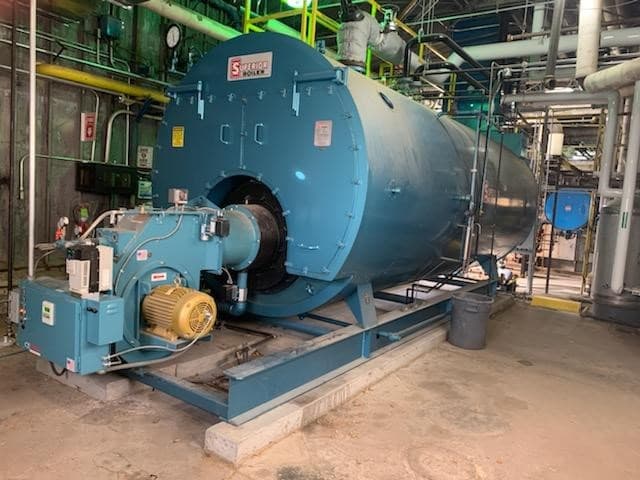
 Blowdown is a common practice in many industries that use boilers, including power plants, chemical plants, and refineries. During the blowdown process, you discharge a portion of the water in the boiler to remove impurities and prevent the buildup of minerals. This helps prevent scale and corrosion. However, the blowdown process can result in the loss of significant amounts of heat energy. This is because the hot water being discharged contains a large amount of thermal energy, which typically escapes down the drain. However, you don’t have to let that liquid gold disappear into the sewer. A blowdown heat recovery system allows you to capture this heat and put it to use. In this article we cover the basics of a blowdown heat recovery system.
There are several types of blowdown heat recovery systems, each with their own advantages and disadvantages. Two common types are flash tanks and heat exchangers. The type of system you use will depend on the pressure and size of your boiler.
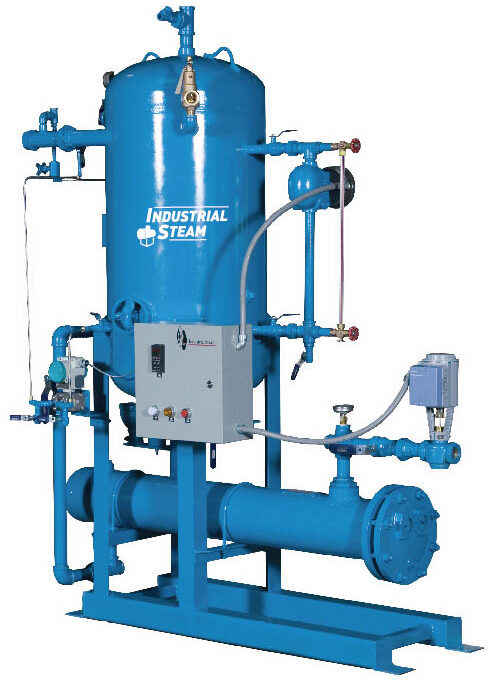
FLASH VESSEL
Flash vessels take the blowdown and separate the flash steam from liquid condensate. This separation allows for the low pressure flash steam to carry heat to other areas of the boiler room.
This steam is most commonly piped to heat the boiler feedwater tank. It can also be piped to heat combustion air or used for a number of other heating applications in the boiler room.
Heat Exchanger
A heat exchanger takes the hot liquid condensate and runs it in close proximity to the colder boiler make-up water. A flow control valve regulates the flow rate of the hot condensate inside the heat exchanger. This serves two main purposes.
One, it allows for pre-heating of boiler make-up water. This improves boiler efficiency while recovering energy that would otherwise be wasted.
Two, it lowers the temperature of the condensate before it goes down the drain. This is important because many state laws do not allow for water over 140 degrees to enter the sewer system.
Blowdown Heat Recovery Example Scenario
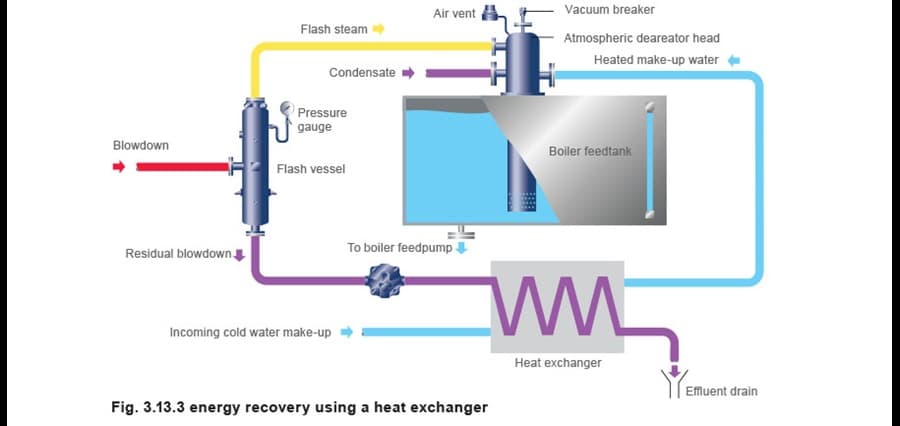
Picture from Spirax Sarco
The US Department of Energy discusses heat recovery in a steam tips sheet. They share a good example of annual savings that is achievable by installing one of these systems. They look at a boiler that is blowing down continuously at a rate of 3,200 lb/hr. The boiler produces 50,000 lb/hr of 150-pounds-per-square-inch-gauge (psig) steam. In the steam tips sheet they perform some calculations. Ultimately, they are able to show that a blowdown heat recovery system would result in a cost savings of $68,000 per year.
With savings like that, you can see why heat recovery systems are so important.